Second Edition · Revised & Expanded
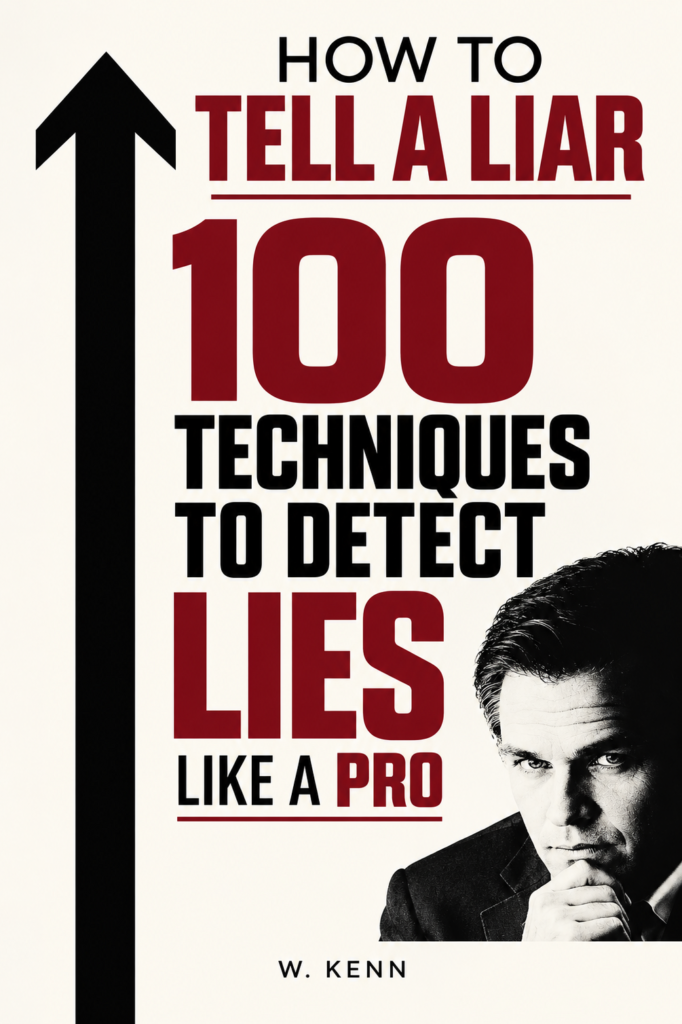
Has someone in your life left you wondering whether they’re telling the truth? How to Tell a Liar is a practical field guide to the 100 signs worth watching, the myths worth forgetting, and the questions that actually bring out the truth.
- 100 techniques grouped by type: face and eyes, body, voice, words and stories, emotional reactions, texting and dating apps, and asking better questions
- Myth Checks on popular “signs” that don’t hold up, like looking up and to the right
- Chapters on lies from children, partners and coworkers, and what to do once you suspect one
- A printable Lie Signs Quick Checklist
By W. Kenn · PDF ebook · 6×9 in, 63 pages · Instant download
Why most people can’t tell a liar (and how to do better)
Research on lie detection is humbling: on average, people tell a lie from the truth only about 54% of the time, barely better than a coin toss. The problem isn’t that there are no signs. It’s that most people look for the wrong ones, judge from a single clue, and forget that honest people get nervous too.
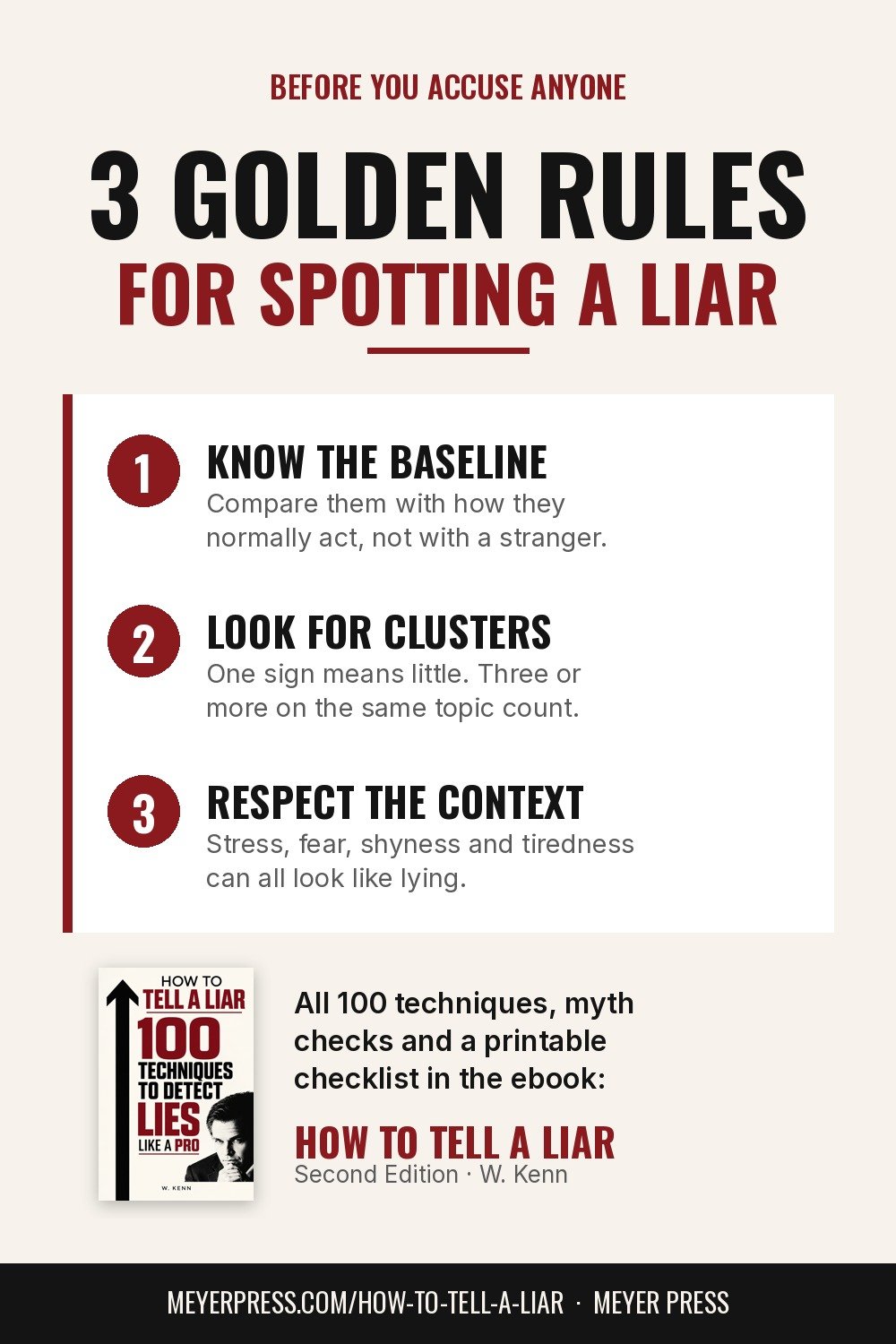
This book teaches you to read people the careful way. Before any technique, you’ll learn the three golden rules that make every sign more accurate:
- Know the baseline. Compare a person with how they normally behave, not with a stranger.
- Look for clusters. One sign means little; three or more on the same topic deserve attention.
- Respect the context. Stress, fear, shyness, culture and tiredness can all look like lying.
What’s inside How to Tell a Liar
- Part One: Understanding Lies. Why people lie, the different types of lies, how lying starts in childhood, and when it becomes a pattern.
- Part Two: Reading People Without Fooling Yourself. The three golden rules and the myths that fool even smart people.
- Part Three: The 100 Techniques. The face and eyes, the body, the voice and breathing, words and stories, emotions and reactions, texting, dating apps and video calls, and asking better questions.
- Part Four: Lies in Real Life. When your child, your partner, or a coworker is lying.
- Part Five: What to Do Next. Eight calm steps for when you suspect a lie, from checking what you can to rebuilding trust.
- Appendix. The Lie Signs Quick Checklist, ready to print.
A few of the 100 techniques
- Don’t rely on eye direction. The famous “up and to the right” rule has been tested and doesn’t hold up. The book explains what eyes can and can’t tell you.
- Not actually saying no. “I would never do something like that” talks about character, not about what happened. Truthful people usually give a direct denial.
- Too few real details. Real memories tend to be rich in sounds, exact words and small surprises; invented stories are often thinner and more general.
- The story changes. Small details vary in honest retellings; what matters is when the core facts change: who, where and when.
- Distancing language. “That woman” instead of a name, or “the vehicle” instead of “my car”.
Honest about what it can do
No book can turn you into a human lie detector, because no such thing exists. The signs in this book are warning signs, not proof. What it will do is make you a sharper, calmer and fairer observer of people.
Free PDF from Meyer Press. You’ll also get occasional emails with new books and printables. Unsubscribe anytime.
Frequently asked questions
Who wrote How to Tell a Liar?
W. Kenn. The first edition was published in 2015; this second edition, revised and expanded, is published by Meyer Press in 2026.
What’s new in the second edition?
The book has been rewritten from cover to cover. The 100 techniques are grouped by type, myths are clearly marked, and there are new chapters on lying over text, on dating apps and on video calls, on asking questions that bring out the truth, and on what to do once you suspect a lie. It ends with a printable checklist.
What format is it?
A 63-page PDF ebook (6×9 in) with a clickable table of contents. You can read it on a phone, tablet, e-reader or computer, or print the checklist.
Can this book prove that someone is lying?
No, and no book can. The signs help you notice when something deserves a closer look and ask better questions. They should never be the only basis for an accusation or an important decision.
How do I get the book after paying?
Checkout is handled by Gumroad. You get a download link right away and by email.
Save this for later on Pinterest