You love them. That’s not the problem. The problem is that their moods have become your weather. When they’re distant, you panic. When they’re upset, you scramble to fix it. And somewhere along the way, you stopped knowing where they end and you begin.
If that sounds familiar, learning how to detach with love may be the most loving thing you ever do, for them and for yourself.
In this guide, you’ll learn what detaching with love really means, how it differs from pulling away, seven practical steps to start today, and how to detach with love from family or a loved one with an addiction.
What does “detach with love” mean?
To detach with love means you keep caring about someone while letting go of the need to control, fix or rescue them. You stay warm and connected, but you stop making their choices, feelings and problems your responsibility.
The phrase comes from Al-Anon, the support group for families and friends of people struggling with alcohol. It was a lifeline for people who had spent years trying to manage someone else’s life. Today it’s used far more widely, by anyone who loves deeply and keeps losing themselves in the process.
Detaching with love isn’t building a wall. It’s putting down a weight that was never yours to carry.
Detaching with love vs. pulling away
Many people avoid detachment because they think it means going cold. It doesn’t. Here’s the difference:
- Pulling away is punishment: silence, withdrawal, “fine, do what you want.”
- Detaching with love is respect: “I trust you to handle this, and I’m here if you need me.”
- Pulling away is driven by hurt and wants a reaction.
- Detaching with love is driven by calm and doesn’t need one.
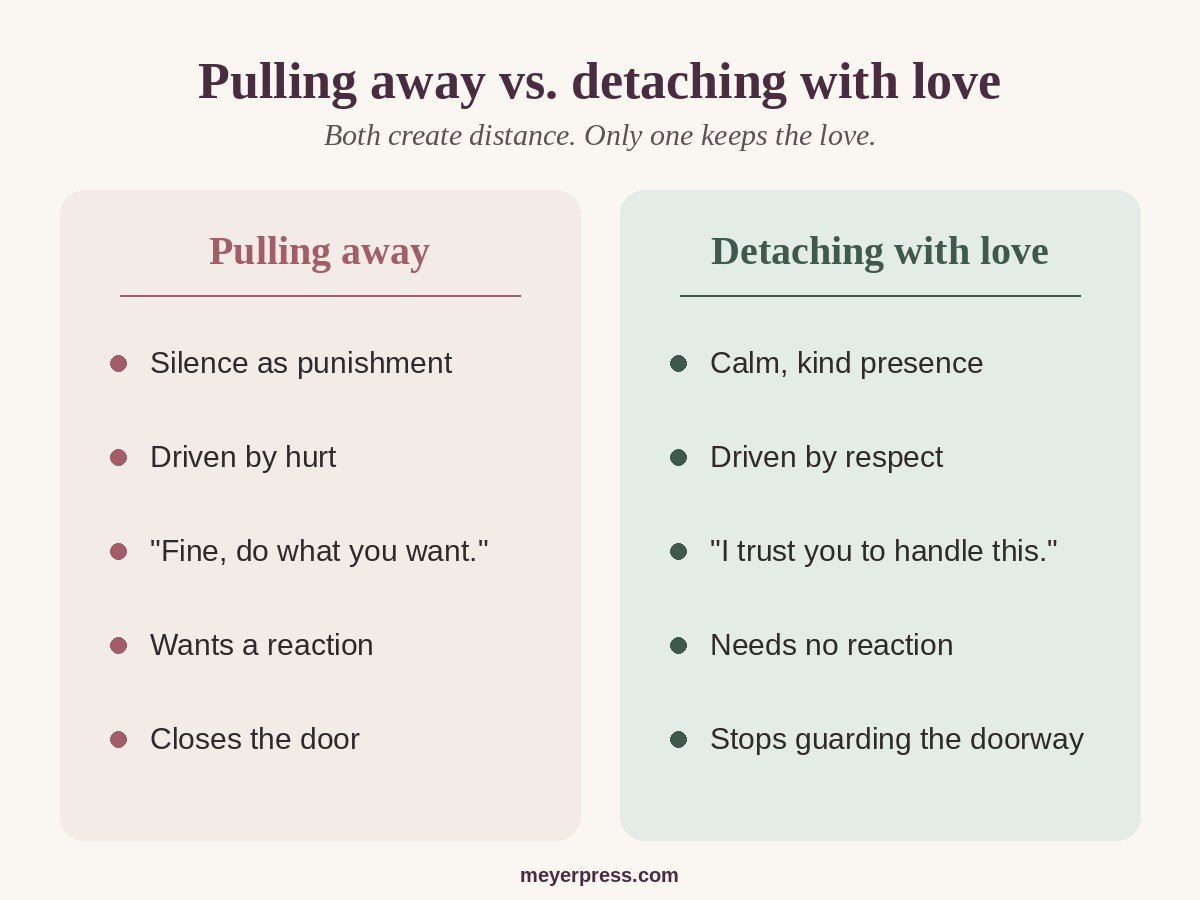
One closes the door. The other simply stops you from standing in the doorway all day, waiting.
Signs you need to detach with love
You might benefit from learning to detach if you often:
- Feel responsible for your partner’s happiness or bad moods
- Over-explain, apologize first or give more to keep the peace
- Check your phone constantly when they haven’t replied
- Try to change, rescue or “help” someone who hasn’t asked
- Feel exhausted, anxious or resentful in a relationship you chose
- Lose track of your own needs, friends or interests
These are classic signs of over-loving. Your ego believes that if you just love hard enough, everything will be safe. Detachment teaches it a calmer way.
How to detach with love: 7 steps
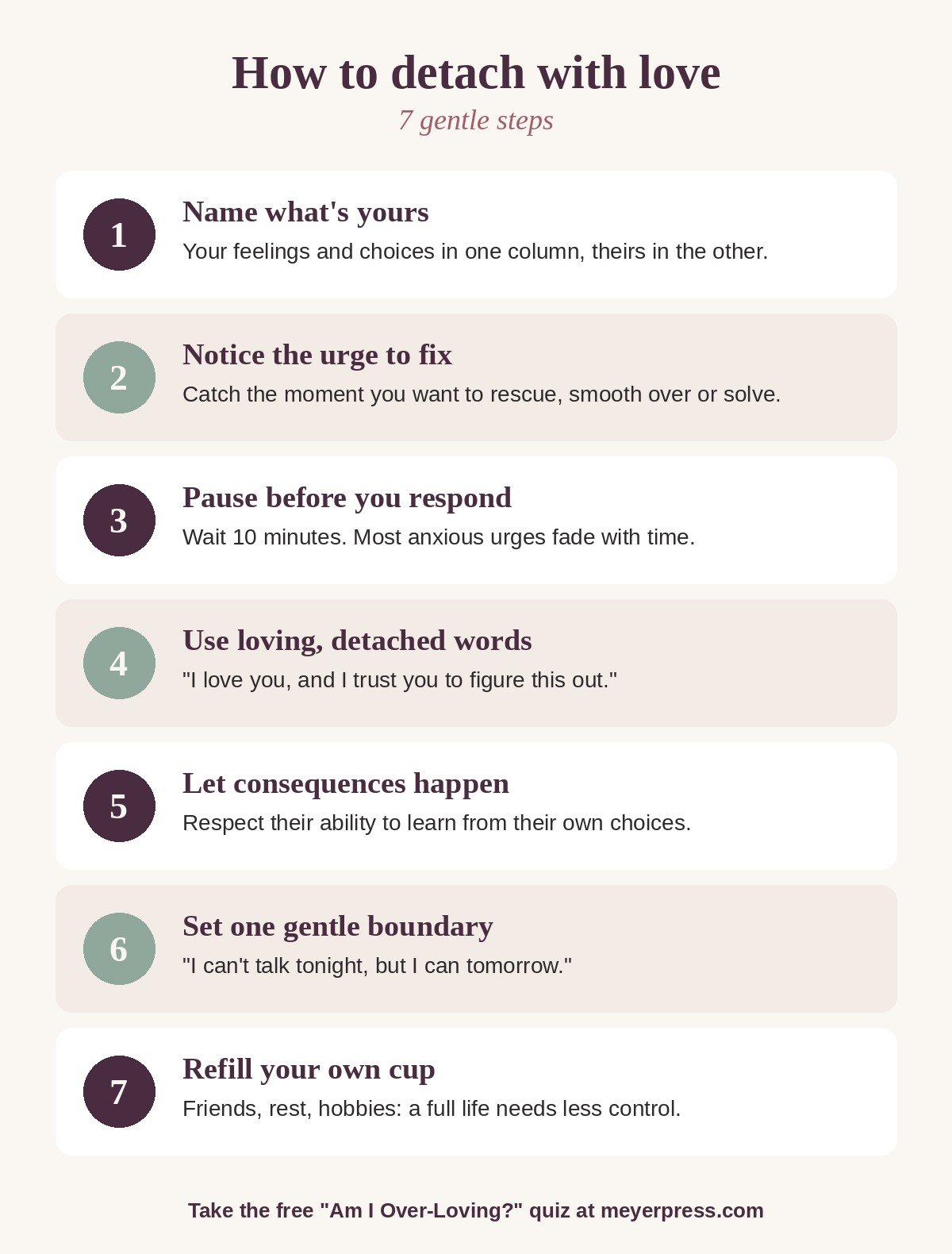
1. Name what’s yours and what’s theirs
Draw two columns on paper: “Mine” and “Theirs.” Your feelings, choices and actions go in your column. Their moods, decisions and reactions go in theirs. This simple exercise makes it visible how much you’ve been carrying that doesn’t belong to you.
2. Notice the urge to fix
Before you can stop rescuing, you have to catch yourself doing it. Over the next week, notice the moment you feel the pull to step in, smooth things over or solve their problem. Just name it: “There’s the urge to fix.” Awareness comes first.
3. Pause before you respond
When you feel that pull, wait. Ten minutes is enough to start. Breathe, step outside, make a cup of tea. Most anxious urges fade when you give them a little time, and then you can choose your response instead of reacting.
4. Use loving, detached language
Detachment sounds kind. Try phrases like:
- “I love you, and I trust you to figure this out.”
- “That sounds really hard. What do you think you’ll do?”
- “I’m not going to argue about this, but I’m here when you want to talk.”
- “That’s your decision to make.”
5. Let natural consequences happen
If you always catch them before they fall, they never learn to balance. Letting someone experience the results of their own choices isn’t cruel. It’s a sign of respect for their ability to grow.
6. Set one gentle boundary
Boundaries are the structure that makes detachment possible. Start small: “I can’t talk about this tonight, but I can tomorrow.” Say it warmly, without over-explaining. You don’t need permission to protect your peace.
7. Refill your own cup
Over-lovers pour everything outward. Detachment creates space, and that space needs filling with you: friends, rest, hobbies, quiet mornings, things that make you feel like yourself again. The more full your life is, the less you need to control anyone else’s.
Not sure if you’re over-loving?
Take the free 2-minute “Am I Over-Loving?” quiz and get a free guide with your first steps to calmer, more balanced love.
How to detach with love from family
Family can be the hardest place to detach, because the patterns started there. You may have been the peacemaker, the fixer or the one who held everyone together long before you ever had a partner.
Detaching with love from a parent, sibling or adult child looks like:
- Listening without immediately offering solutions
- Letting them make choices you disagree with, without arguing them out of it
- Saying no to requests for money, time or rescue when it costs you too much
- Keeping visits or calls to a length that feels good, not draining
- Loving who they are today, instead of waiting for who you wish they would be
A helpful phrase for family: “I love you, and I’m not going to carry this for you.” You can stay close and still stop being everyone’s emergency service.
How to detach with love from an addict
This is where the idea of detaching with love began. If someone you love is struggling with alcohol or drugs, you’ve probably tried everything: pleading, hiding bottles, covering for them, paying their bills, checking up on them at all hours. It’s exhausting, and it rarely works.
Detaching with love from someone with an addiction means:
- Stop managing the addiction. Their recovery is theirs. You can’t want it more than they do.
- Stop shielding them from consequences. Covering for missed work or paying debts can keep the cycle going.
- Keep loving them openly. “I love you, and I won’t help you hurt yourself.”
- Get support for yourself. Groups like Al-Anon and Nar-Anon exist for families, and a counselor can help you through it.
If you ever feel unsafe, your safety comes first. Detachment is never a reason to stay in danger. In the US, the SAMHSA National Helpline (1-800-662-4357) offers free, confidential support for families dealing with addiction, 24 hours a day.
Detach with love quotes and affirmations
Short phrases help when your old habits start pulling you back. Save a few of these to your phone or write them on a sticky note:
I can love you without carrying you.
Your choices are yours. My peace is mine.
I don’t have to fix it to care about it.
Letting go is not giving up. It’s making room.
I am allowed to love deeply and still protect myself.
Pick the one that makes you exhale, and repeat it the next time you feel the urge to rescue.
What detaching with love feels like at first
Be prepared: it may feel uncomfortable, even selfish, at the beginning. Your ego is used to managing everything, and letting go can feel like danger. That discomfort is not a sign you’re doing it wrong. It’s a sign you’re doing something new.
Over time, most people notice they feel calmer, sleep better and argue less. Often, the relationship improves too, because love without control has room to breathe.
Frequently asked questions
Is detaching with love the same as ending a relationship?
No. Detaching with love is about how you show up inside a relationship, not whether you stay. You can detach and remain deeply committed. Sometimes, though, detachment gives you the clarity to see whether a relationship is right for you.
Can you detach with love from family?
Yes. The same principles work with parents, siblings and adult children. You can love your family and still stop taking responsibility for their choices.
How long does it take to learn to detach?
It’s a practice, not a one-time decision. Many people notice a shift within a few weeks of consistent small steps, but old habits can return under stress. Be patient with yourself.
What if detaching makes them angry?
People used to you fixing everything may push back at first. Stay kind and consistent. If someone responds to your boundaries with threats or abuse, that is not a detachment problem, and it’s important to reach out for support. In the US, you can call the National Domestic Violence Hotline at 1-800-799-7233.
Is detaching with love selfish?
No. Taking care of yourself so you can show up calmly is not selfish. Over-giving often leads to resentment and burnout, which hurts both people. Detaching with love protects the relationship by making it more balanced.
What’s the difference between detaching and setting boundaries?
Detaching is an inner shift: letting go of responsibility for someone else’s choices and feelings. Boundaries are the outer actions that support it, like saying no or limiting a conversation. You usually need both.
Can detaching with love save a relationship?
It often helps. When one person stops controlling and the other stops being controlled, there’s more room for honesty and respect. It can’t fix every relationship, but it gives a healthy one space to grow. For a step-by-step plan, see how to heal a codependent relationship.
Love deeply, without losing yourself
Learning how to detach with love doesn’t mean caring less. It means caring in a way that leaves room for both of you. Start with one step this week, and notice what changes.
If you’d like to go deeper, explore the Low Maintenance Ego books and the Detach With Love journal, or start with the free “Am I Over-Loving?” quiz.
This article is for education and self-reflection and isn’t a substitute for professional support. See our disclaimer.
1 thought on “How to Detach With Love: What It Means and 7 Steps to Start”
Comments are closed.