Losing yourself in a relationship means slowly trading away your own needs, opinions, friendships and routines until your life revolves around your partner. It rarely happens all at once. It happens in small, reasonable-feeling choices, and one day you realize you can’t remember what you wanted before them.
If that sentence made your stomach drop a little, you’re not broken, and you’re not alone. This guide walks through the signs, why it happens, and how to find your way back to yourself without leaving the relationship unless you choose to.
In this guide
What does losing yourself in a relationship mean?
Healthy love has room for two whole people. Picture two circles that overlap in the middle. The overlap is your shared life: your home, your plans, your trust. But each circle still has plenty of space that belongs only to that person.
When you lose yourself, your circle shrinks until it almost disappears inside theirs. Your mood follows their mood. Your weekends become their weekends. Your opinions quietly match theirs. From the outside, it can look like closeness. From the inside, it often feels like exhaustion, anxiety, or a strange kind of loneliness, even when you’re together.
9 signs you’re losing yourself in a relationship
You don’t need to recognize all of these. Even two or three are worth paying attention to.
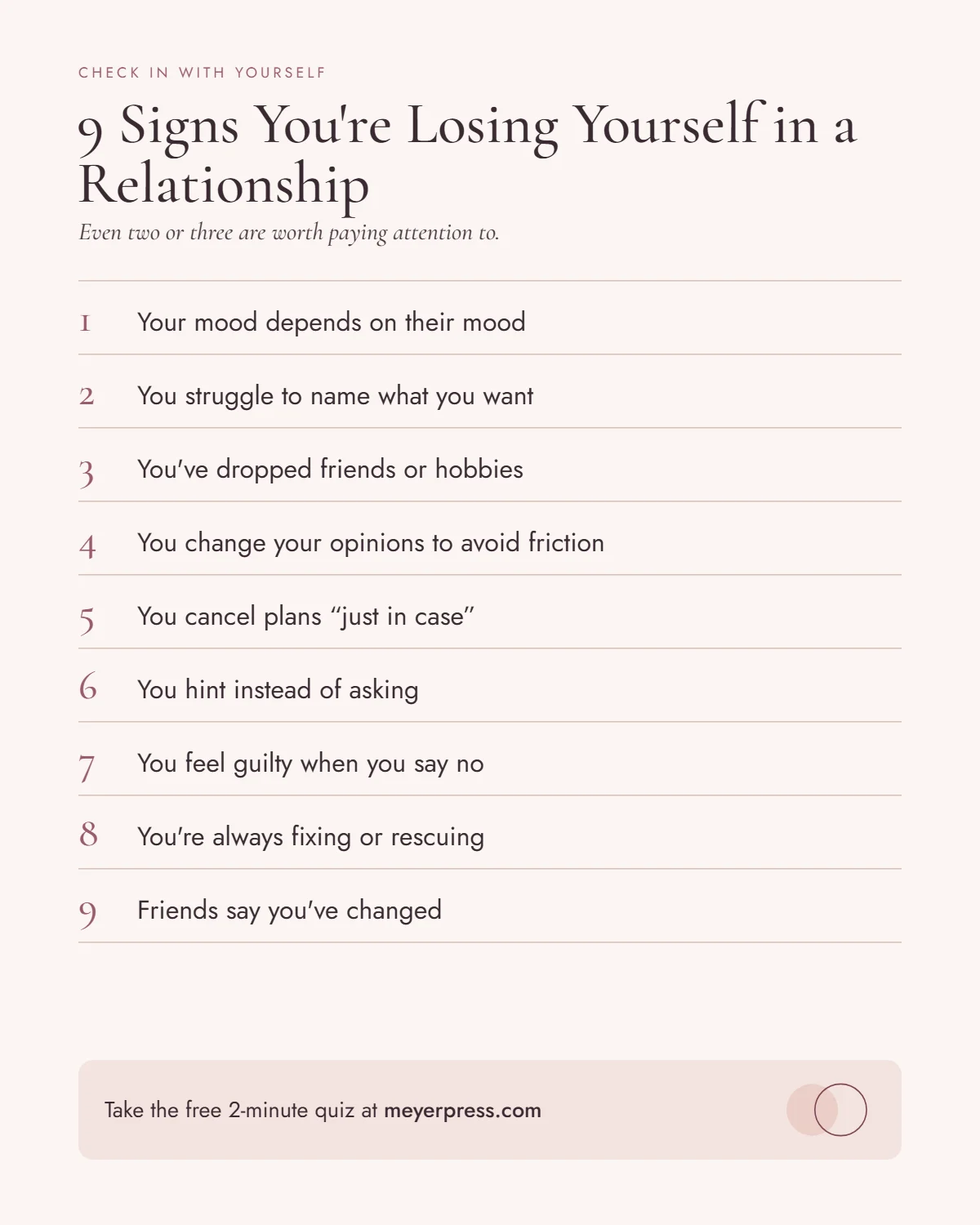
1. Your mood depends on their mood
When they’re happy, you relax. When they’re quiet or stressed, you can’t settle until you’ve figured out what’s wrong and fixed it.
2. You struggle to name what you want
Someone asks where you’d like to eat, what you want for your birthday, or how you’d spend a free Saturday, and your mind goes blank. Or your first thought is, “What would they want?”
3. You’ve dropped friends or hobbies you used to love
It wasn’t one big decision. You skipped a class here, cancelled on a friend there, and slowly stopped doing the things that made you feel like you.
4. You change your opinions to avoid friction
You agree with things you don’t really believe, or you stay quiet about what matters to you because disagreeing feels risky.
5. You cancel plans “just in case they need you”
Your calendar stays open for them, even when they haven’t asked, and your own plans feel optional.
6. You hint instead of asking
Saying “I need this” feels like too much, so you hint, hope they’ll notice, and feel hurt when they don’t.
7. You feel guilty when you say no
Even small no’s leave you anxious, over-explaining, or replaying the moment later.
8. You’re always fixing, reminding or rescuing
You manage their appointments, smooth over their mistakes, or cover for them with friends and family. It feels like love, but it leaves you tired and quietly resentful.
9. Friends say you’ve changed, and they don’t mean it kindly
People who knew you before the relationship say they miss the old you. That’s often the clearest outside signal that something has shifted.
Not sure where you stand? Take the free 10-question “Am I Over-Loving?” quiz. It takes about two minutes and shows how much of your sense of self is tied to your partner right now.
Why do we keep losing ourselves in a relationship?
Losing yourself in a relationship is usually a learned habit, not a character flaw. A few common roots:
- You learned that keeping the peace keeps you safe. If you grew up around tension, you may have learned to read moods and adjust yourself to prevent conflict.
- You believe being needed means being loved. Helping, fixing and giving can feel like the way to earn your place.
- You’re afraid of being “too much.” So you make yourself smaller, quieter and easier to love.
- You’re waiting for them to change. When you’re focused on who your partner could become, it’s easy to put your own life on pause.
Some people call this pattern codependency: letting another person’s feelings and choices shape your own so much that you lose track of yourself. You don’t need a label to start changing it, though. You just need to notice it.
If these signs are part of a bigger give-and-take pattern with your partner, read our guide on how to heal a codependent relationship.
Losing yourself in a relationship vs. healthy closeness
| Healthy closeness | Losing yourself |
|---|---|
| You share a life and keep your own friends | Your social life has shrunk to theirs |
| You can disagree and still feel close | Disagreeing feels dangerous, so you don’t |
| You care about their feelings | You feel responsible for their feelings |
| You ask for what you need | You hint and hope |
| You make plans of your own without guilt | Your plans always come second |
| Their bad day is their bad day | Their bad day becomes your bad day |
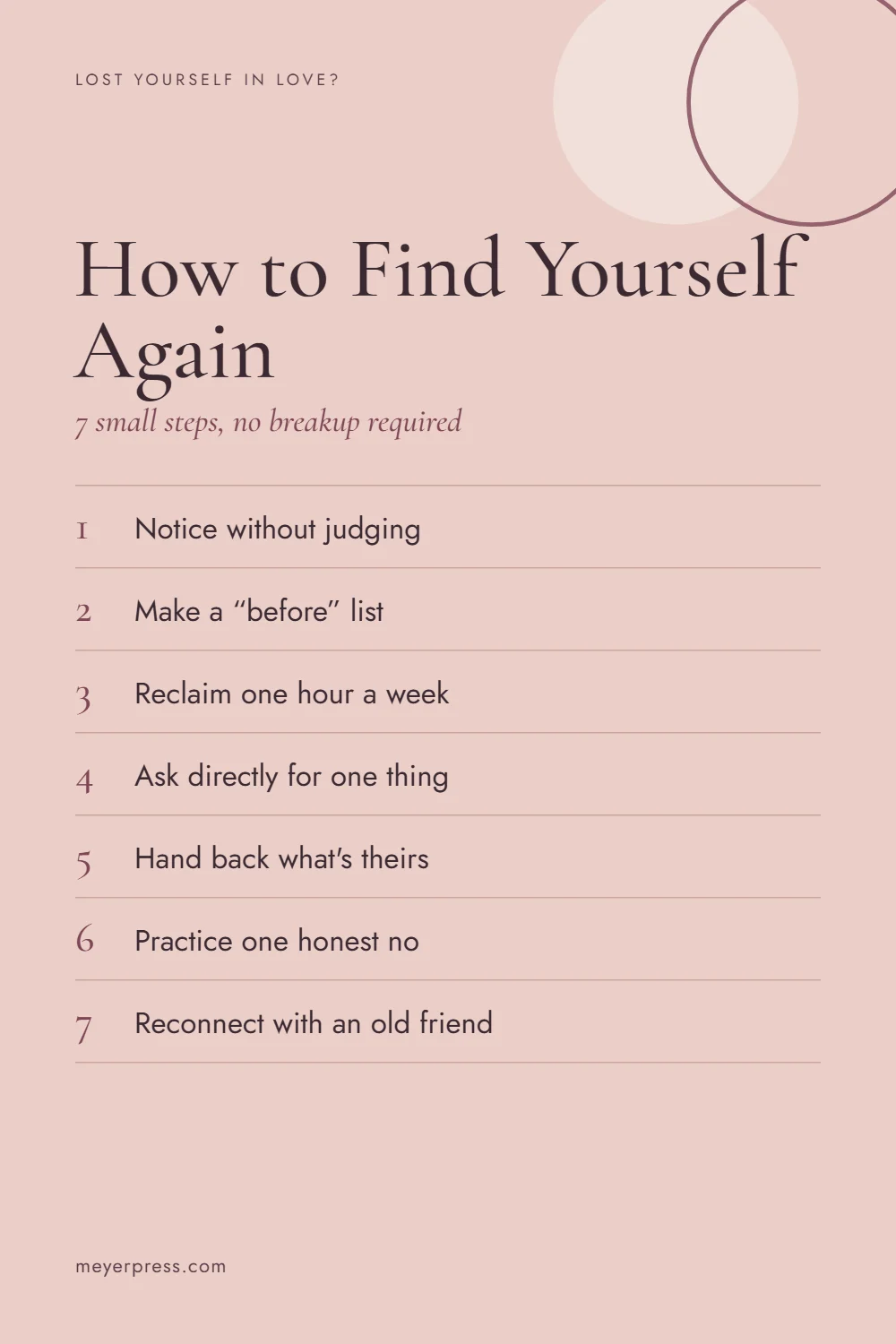
How to find yourself again after losing yourself in a relationship: 7 steps
You don’t have to blow up your relationship to come back to yourself. Start small and stay consistent.
1. Notice without judging
Three times a day, pause and ask: “Is this feeling mine or theirs?” Simply naming it creates space between their mood and yours.
2. Make a “before” list
Write down five things you loved doing before this relationship, three people you used to feel close to, and two opinions you used to state proudly. Circle one from each list and bring it back this week.
3. Reclaim one hour a week that’s only yours
A class, a walk, a coffee alone, a creative project. Put it in your calendar and protect it the way you’d protect a work meeting.
4. Ask directly for one small thing
Try this simple shape: “I feel ___. I would love ___. Would you be willing to ___?” A clear ask gives your partner a fair chance to show up, and it reminds you that your needs are allowed.
5. Hand back one thing that’s theirs
Pick one task you do that is really your partner’s responsibility. Tell them calmly that you’re stepping back, then let it stay theirs. This is a core part of learning to detach with love: caring without carrying.
6. Practice one honest no
Say no to something small this week, without a long explanation. Notice that the discomfort passes, and that you’re still okay.
7. Reconnect with one person who knew you before
Send the message. Make the coffee date. People who knew you before this relationship can help you remember who you are.
How to stop losing yourself in your next relationship
If you’re single or dating again, these habits help you stay whole from the start:
- Keep at least two regular commitments that are only yours, like a class, a sport or a weekly friend date.
- Notice how fast you start rearranging your life. Speed is often a warning sign.
- Share real opinions early, including small disagreements.
- Watch how they respond when you say no. Someone safe can hear it.
- Check in with yourself monthly: “Am I still doing the things that make me feel like me?”
When to get more support
Sometimes losing yourself in a relationship is a sign of something more serious. If your partner controls who you see, monitors your phone, criticizes you constantly, threatens you, or makes you afraid, please reach out for help. In the U.S., you can contact the National Domestic Violence Hotline at 1-800-799-7233 or text START to 88788. If you’re in immediate danger, call 911.
A licensed therapist can also help you untangle long-standing patterns, and peer groups like Co-Dependents Anonymous (coda.org) offer free support.
Frequently asked questions
Is it normal to lose yourself in a relationship?
It’s very common, especially early on or during stressful seasons. What matters is noticing it and taking small steps back toward your own life before resentment builds.
Can you find yourself again without breaking up?
Yes. Many people rebuild their sense of self inside a relationship by keeping their own friendships, asking for what they need and setting kind boundaries. Often the relationship gets healthier too.
What are the first signs of losing yourself in a relationship?
Early signs include checking your partner’s mood before your own, struggling to make small decisions alone, and quietly skipping things you used to enjoy.
Is losing yourself in a relationship the same as codependency?
They overlap. Losing yourself is one of the most common signs of codependent patterns, where your sense of worth and safety becomes tied to another person.
Come back to yourself, one small step at a time
Losing yourself in a relationship didn’t happen in a day, and finding yourself won’t either. But every small choice counts: one honest no, one hour that’s yours, one clear ask. Love works best between two whole people, and you deserve to be one of them.
Start here: take the free “Am I Over-Loving?” quiz to see where you are today. If you want a guided path, the Detach With Love book and 30-day journal walk you through it step by step.
1 thought on “Losing Yourself in a Relationship: 9 Signs and How to Come Back”