You don’t want to leave. You love this person. You just want the relationship to stop feeling like a job you can never clock out of: tracking their moods, smoothing every conflict, giving and giving and wondering why it never feels like enough.
If you’re wondering how to heal a codependent relationship, or how to fix one before it wears you both out, here’s the honest good news: many codependent relationships can heal. It takes both people, and it rarely happens through one big conversation. It happens through small, steady changes in how you give, how you speak up and how you care for yourself.
In this guide, you’ll learn whether a codependent relationship can be healed, what codependency looks like day to day, seven practical steps to heal it, and how to know when healing means letting go.
In this guide
Can a codependent relationship be healed (or fixed)?
Yes, a codependent relationship can be healed when both people are willing to look at the pattern and change their part in it.
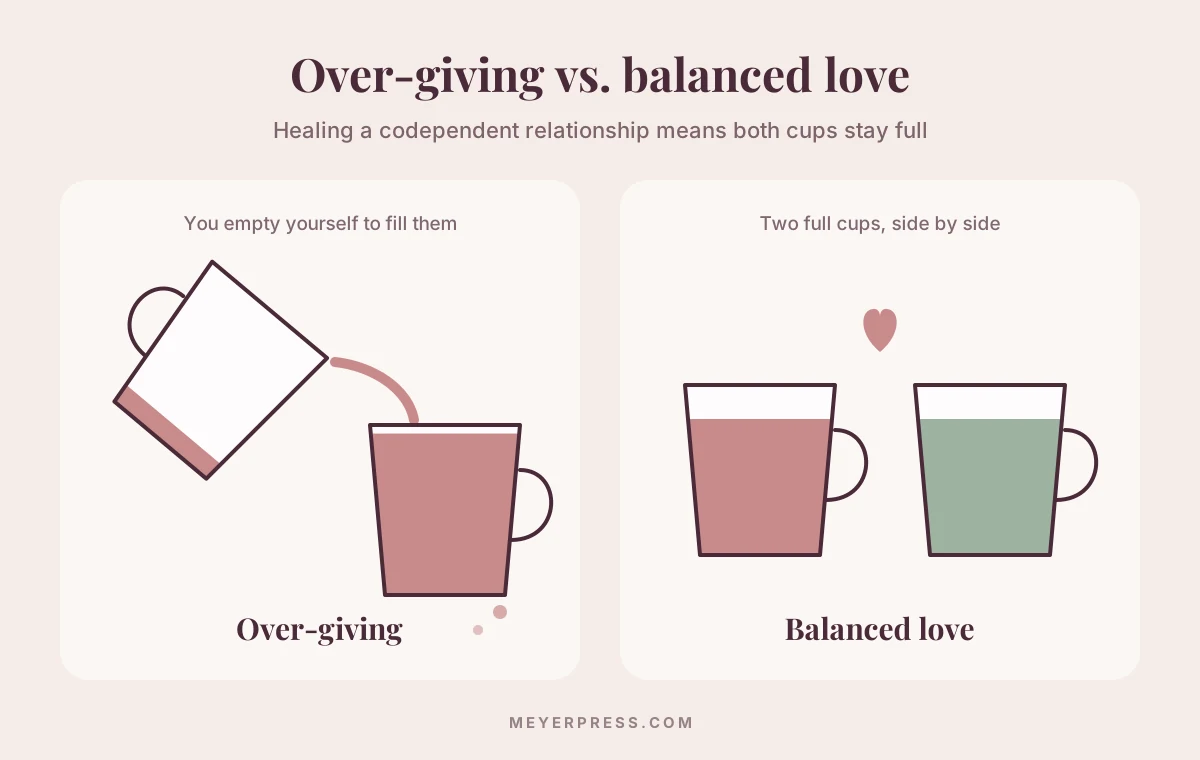
Codependency isn’t a fixed trait. It’s a learned way of relating, often where one person over-functions (rescues, manages, gives too much) and the other under-functions (leans, avoids, lets the other carry the weight). Because it was learned, it can be unlearned.
Two things make healing much more likely:
- Both partners want the relationship to change. You can start the work alone, and your changes will shift the dynamic. But a relationship can only fully heal when both people take part.
- There is no abuse. Codependency and abuse are different things. If your partner threatens, frightens or hurts you, the steps below are not the answer. Your safety is. (See the support section at the end.)
What a codependent relationship looks like day to day
Codependency rarely looks dramatic. It usually looks like love that has quietly tipped out of balance:
- You can tell your partner’s mood from the way they close a door, and you start adjusting before they say a word.
- You apologize first, even when you’re not sure what you did.
- You cancel plans with friends because they seemed “off” and you wanted to be there just in case.
- You handle their problems, their appointments, their difficult conversations, and feel strangely anxious when they handle them alone.
- You say “I’m fine” when you aren’t, because your needs feel like one more thing to manage.
If you’re nodding along, you may be over-loving. Not sure? Take the free 2-minute “Am I Over-Loving?” codependency quiz to see where you are.
How to heal a codependent relationship: 7 steps
1. Notice the rescue urge
Healing starts with awareness, not willpower. For one week, simply notice the moment you feel pulled to fix, smooth over or step in. You don’t have to stop yet. Just name it in your head: “There’s the urge to rescue.”
Most people are surprised by how often it happens. That’s not a reason for shame. It’s the map you need.
2. Stop managing their moods
Your partner’s feelings are real, and they matter. But they are theirs to feel and theirs to handle. When they’re upset, try staying present without jumping in to fix it:
- “That sounds really frustrating. I’m here.”
- “Do you want advice, or do you just want me to listen?”
Then let the mood pass on its own. You’ll notice it usually does, without you rearranging your whole evening around it.
3. Say one small “no” each week
Over-givers often say yes before they’ve even checked how they feel. Practice with something low-stakes: “I can’t pick that up today, but I can tomorrow.” Or “I’d rather stay in tonight.”
Keep it warm and short. You don’t need to over-explain. Each small no teaches your nervous system that the relationship survives your honesty, and teaches your partner that you’re a person with limits, not a service.
4. Rebuild a life outside the relationship
When a relationship becomes your whole world, every wobble in it feels like an earthquake. Start putting weight back on other parts of your life: a friend you’ve lost touch with, a class, a walk alone, a hobby you dropped.
This isn’t pulling away from your partner. It’s giving the relationship room to breathe, and giving you somewhere to stand when things get hard. If you’ve felt yourself fading, our guide to losing yourself in a relationship walks through how to come back.
5. Name your needs out loud
In codependent relationships, one person often expects the other to guess their needs, or hides them completely. Healing means saying them plainly:
- “I need us to split the evening chores.”
- “I need a little quiet time when I get home before we talk.”
- “It would mean a lot if you asked how my day went.”
It may feel exposing at first. That’s normal. A need spoken out loud can be met. A need kept secret just turns into resentment.
6. Let them face their own consequences
If you always cover for them, call in sick for them, pay their bills or explain them to others, they never get to feel the weight of their own choices, and you never get to put it down.
Letting natural consequences happen isn’t punishment. It’s respect. It says, “I trust you to handle your life.” This is the heart of learning how to detach with love: you keep caring, and you stop carrying.
7. Get support for both of you
Codependent patterns are often old, sometimes older than the relationship itself. You don’t have to untangle them alone. Helpful options include:
- Couples therapy, to change the pattern together with a neutral guide
- Individual counseling, to understand where your over-giving started
- Support groups like Co-Dependents Anonymous (CoDA), or Al-Anon if your partner struggles with alcohol
Asking for help isn’t a sign the relationship is failing. It’s a sign you’re taking it seriously.
The ego behind over-giving
Here’s something most articles about codependency skip: over-giving isn’t only about love. Often, it’s about the ego.
Not the loud, arrogant kind of ego. The anxious kind. The part of you that believes, “If I’m needed, I’m safe. If I’m useful, they won’t leave.” Every time you rescue, manage or give past your limit, that part of you gets a little reassurance, and a little more convinced it’s in charge of keeping the relationship alive.
Healing a codependent relationship means giving that anxious ego less to do. You don’t have to fight it. You just stop letting it run the relationship. Each time you pause instead of fixing, you show it a new truth: you can be loved without being needed for everything.
This is what we call having a low maintenance ego in love: steady enough that you don’t need constant proof, and free enough to let the people you love be themselves.
What healing looks like, week by week
Change in a codependent relationship is usually gradual, and a little bumpy:
- At first, it feels uncomfortable, even selfish. Your partner may push back because the old system worked for them too.
- After a few weeks, you’ll catch the urge to rescue faster, and recover from it sooner.
- Over time, conversations get more honest, resentment softens, and the relationship starts to feel like two people choosing each other, not one person holding everything up.
Old habits will return under stress. That’s not failure. Just notice, and begin again.
When healing means letting go
Sometimes, as you stop over-giving, you see the relationship more clearly. You may notice that your partner doesn’t want to change, or that the relationship only worked because you carried it.
That clarity is painful, but it’s not a failure. Healing the pattern in you is never wasted, whether the relationship continues or not. Some people stay and grow together. Others realize it’s time to leave, and they leave from a place of strength instead of exhaustion.
Frequently asked questions
Can a codependent relationship become healthy?
Yes. When both people recognize the pattern and work on their part, a codependent relationship can become balanced and healthy. Many couples find couples therapy helpful along the way.
Can you fix a codependent relationship on your own?
You can start alone, and your changes will shift the relationship. But for a full repair, your partner needs to take part too. If they refuse to change anything, that tells you something important.
How long does it take to heal a codependent relationship?
There’s no set timeline. Many people notice small shifts within a few weeks of consistent practice, but deeper change usually takes months. Be patient with yourself and with the process.
Is codependency the same as being in love?
No. Love includes care for both people. Codependency is when one person’s sense of worth or safety depends on managing the other. You can love deeply without losing yourself.
Should I leave a codependent relationship?
Not necessarily. Many codependent relationships heal. But if there’s abuse, or if your partner refuses to change while you keep sacrificing, leaving may be the healthiest choice. A counselor can help you decide.
Get support if you feel unsafe
Codependency is not abuse, but they can overlap. If your partner threatens, controls or hurts you, please reach out for help. In the US, you can call the National Domestic Violence Hotline at 1-800-799-7233, or text START to 88788.
Love deeply, without losing yourself
Learning how to heal a codependent relationship isn’t about caring less. It’s about caring in a way that leaves room for both of you. Pick one step from this list, practice it this week, and notice what changes.
If you’d like to go deeper, explore the Low Maintenance Ego books and the Detach With Love journal, or start with the free “Am I Over-Loving?” quiz.
This article is for education and self-reflection and isn’t a substitute for professional support. See our disclaimer.
2 thoughts on “How to Heal a Codependent Relationship (Without Losing Yourself)”